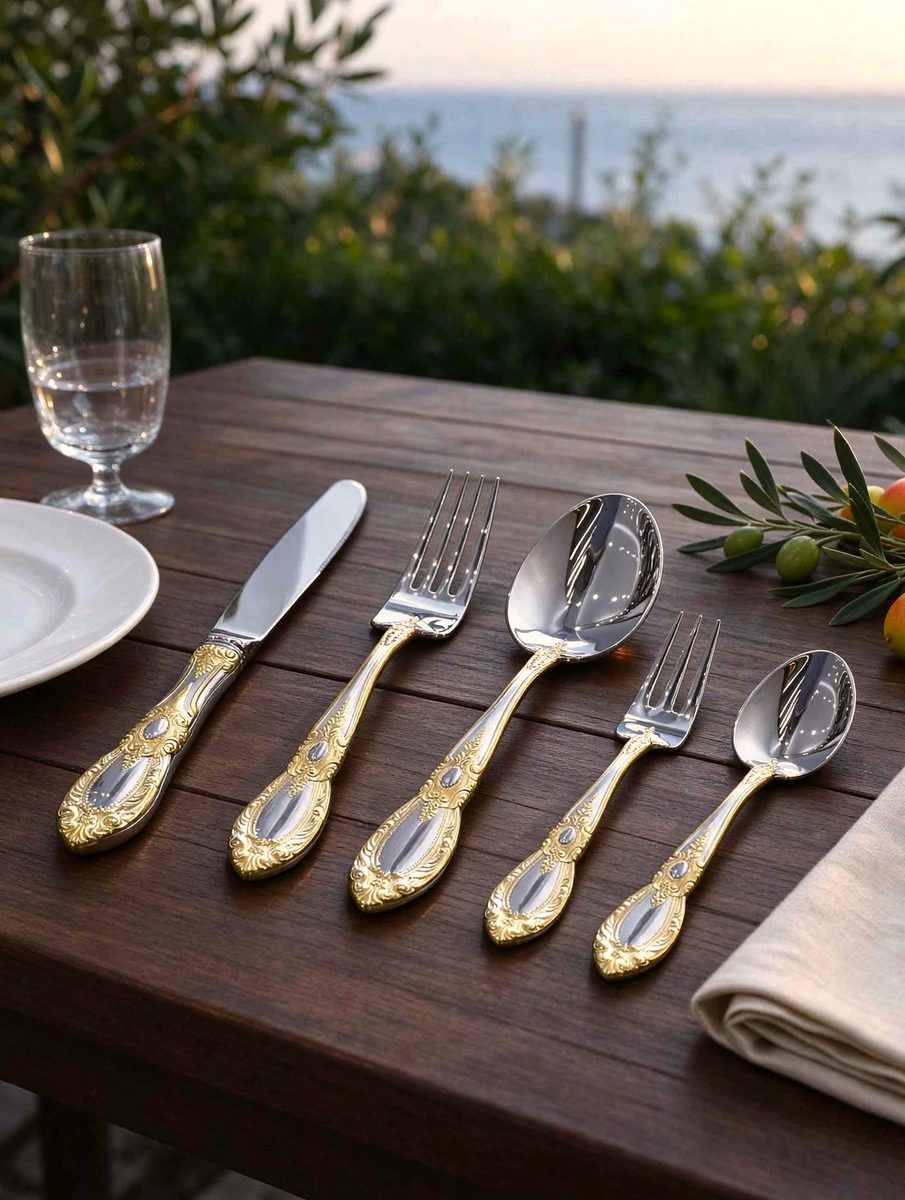
Hotel flatware — the knives, forks, and spoons guests use at every meal — goes through more handling than almost any other item in a hotel. It is set, used, cleared, washed, dried, polished, stored, and set again, hundreds of times a year. The difference between cutlery that still looks new after a season and cutlery that looks tired after a month is rarely the cutlery itself. It is the care routine. This guide sets out the washing, drying, polishing, storage, and handling habits that keep hotel flatware looking new, so your team can protect the investment you made when you chose the sets.
1. Clear and rinse promptly — never let food dry on the piece
The single most effective care habit is also the simplest: do not let food dry on flatware. Dried food, especially acidic food such as tomato, citrus, and vinegar-based dressings, and salty food such as soy sauce and cured meats, can mark a surface if it is left to sit. Train the clearing team to scrape plates and flatware as they clear, and to get used pieces into a rinse or a soak quickly rather than stacking them on a tray to wait.
A short soak in warm water loosens food without any scrubbing, which protects both the finish and the pattern. Avoid leaving flatware soaking for hours, though — a long soak in dirty water can cause its own marks, and pieces left at the bottom of a sink get knocked and scratched. The rhythm to aim for is: clear, scrape, rinse or short soak, wash. If your operation uses a dish pit, make sure flatware is separated from plates and heavy items before it goes into the wash, so it is not crushed under a stack of crockery.
2. Wash with the right routine for your operation
Most hotels wash flatware in a commercial dishwasher, and a good machine routine is the backbone of flatware care. Load pieces with the handles down and the eating ends up where your machine’s rack allows, so water and detergent reach every surface and pieces do not nest together and trap food. Do not overload the rack: pieces that are packed too tightly do not wash properly, and they knock against each other, which causes the small nicks that make a set look worn.
Use the detergent and the wash cycle your machine supplier recommends, and check the water temperature and the rinse cycle regularly. A rinse that is too cool leaves water spots; a wash that is too harsh can dull a finish over time. If you wash by hand — for example, for a small outlet or for pieces that need extra attention — use warm water, a mild detergent, and a soft cloth or sponge, never an abrasive pad or a scouring powder. Rinse thoroughly, because detergent residue left on a piece will show as a dull film once it dries.
Whatever the method, the principle is the same: clean flatware gently and completely, and never let the washing step become the step that damages the pieces. If you are choosing a new set, read our guide on how to choose hotel cutlery sets first, and ask your supplier how the finish you are considering performs under your washing conditions.
3. Dry immediately — water spots are preventable
Water spots are the most common complaint about hotel flatware, and they are almost always preventable. They form when water is left to dry on the surface, leaving behind the minerals in the water. The fix is to dry each piece promptly after washing, while it is still warm, rather than leaving a rack of flatware to air-dry on its own.
In a busy operation, the practical method is a quick towel-dry or a pass through a drying cycle, followed by a polish. Use a clean, dry, lint-free cloth, and handle each piece by the handle so you do not leave fingerprints on the eating end. If your water is hard — that is, high in minerals — talk to your supplier about water treatment for the dish area, because softened water makes a visible difference to how flatware dries. A small investment in water quality often pays for itself in the time saved on polishing and in the life of the finish.
4. Polish little and often, not in a big rescue
Polishing is the step that separates hotels whose flatware always looks new from hotels whose flatware only looks good on the day it arrives. The secret is frequency: a quick polish as part of the reset between services takes seconds per piece and keeps marks from building up, while a big polishing session once a month takes hours and never fully recovers a neglected set.
Build polishing into the setting routine. As each piece is set on the table, give it a quick check and a wipe with a dry cloth; any piece with a spot, a mark, or a fingerprint goes back for a re-polish rather than onto the table. Once a week, set aside time for a deeper check of the whole stock: look at each piece under good light, check the finish, and pull out any piece that is bent, nicked, or spotted. A piece that is pulled from service before a guest sees it costs nothing; a piece a guest notices costs you reputation.
5. Handle by the handle, always
How flatware is handled matters as much as how it is washed. Fingers on the eating end leave marks, transfer oils, and undo the polishing that was just done. Train every team member — servers, bussers, polishers, and the dish team — to pick up flatware by the handle, and to carry it in a way that the eating ends do not knock together.
This habit needs to be taught, checked, and reinforced, because it is easy to slip back into grabbing a handful of forks by the tines when the service is busy. Make it easy to do the right thing: provide trays and containers that hold flatware by the handle, keep polishing cloths at the setting station, and give the team a clear rule — if you touch the eating end, you polish the piece again. Guests notice clean, well-handled flatware even if they cannot say why the table looks good; it is one of those details that adds up to a feeling of care.
6. Store flatware dry, separated, and protected
Storage is where many sets quietly deteriorate. Flatware stored damp will spot and, over time, can develop marks that polishing cannot remove. Flatware stored loose in a pile will scratch, nick, and bend as pieces knock against each other. The routine is simple: store pieces only when they are fully dry, separated by type, and protected from contact.
A drawer with dividers, a canteen box with compartments, or a dedicated storage tray all work, as long as each type of piece has its own space and the pieces lie flat rather than in a heap. Keep the storage area itself clean and dry, and keep it away from steam, chemicals, and strong smells, which can all affect the finish. If you store flatware for a banquet or an event that is days away, check it when it comes out of storage and polish it before it is set — even clean storage can leave a light film that a quick polish removes.
7. Inspect, rotate, and retire pieces on a schedule
Even with the best care, flatware wears. The way to manage that is a regular inspection and rotation routine, not a reaction when a guest complains. Once a week, or once a month for a smaller property, go through the stock piece by piece: check the finish, check the edges, check that each piece is straight and flat, and pull out anything that is bent, chipped, spotted, or dull beyond polishing.
Rotate the stock so the same pieces are not always the ones in service — a set that is used evenly wears evenly, and it is easier to keep looking consistent. Keep a small reserve of matching pieces so a pulled piece can be replaced immediately rather than leaving a gap in the set, and confirm with your supplier that the same pattern and finish can be re-ordered later. If you are planning a wider refresh, consider ordering your cutlery as part of a single tableware programme so the cutlery and the rest of the tableware are replaced and matched together.
8. Train the team and write the routine down
None of this works if it lives only in one person’s head. Write the flatware care routine down — a single page is enough — and put it where the team can see it: clear and rinse promptly, wash in the right rack, dry immediately, polish little and often, handle by the handle, store dry and separated, inspect on a schedule. Train every new team member on it in their first week, and check it in practice, not only on paper.
The routine should also name who is responsible for what: who checks the wash cycle, who owns the weekly inspection, who orders replacements, and who trains new starters. When responsibility is clear, the routine survives staff changes; when it is vague, it fades within a month. A written routine is also what lets you compare properties or outlets fairly — if one outlet’s flatware always looks better than another’s, the difference is usually the routine, and a shared standard closes the gap.
A simple daily, weekly, and monthly care routine
| When | Task | Who | What good looks like |
|---|---|---|---|
| Every service | Scrape and rinse promptly; do not let food dry on pieces | Clearing team | No dried food reaches the wash |
| Every service | Wash in racks, not overloaded; dry immediately | Dish team | Pieces come out clean and spot-free |
| Every reset | Quick polish as pieces are set; handle by the handle | Servers | Every set piece is clean, dry, and mark-free |
| Weekly | Deeper inspection under good light; pull damaged pieces | Supervisor | No bent, nicked, or spotted piece in service |
| Weekly | Check storage: dry, separated, protected | Supervisor | Drawers and boxes clean, dry, organised |
| Monthly | Review wash cycle, detergent, and water quality | Manager | Spots and dulling traced to a cause, not accepted |
| Monthly | Check reserve stock and re-order needs | Manager | Spares on hand; replacements ordered before a gap appears |
What to include in your enquiry
When you ask a supplier for a quote on hotel cutlery sets, the care routine is part of the conversation — because the right set is the one your team can keep looking new. Copy and adapt this checklist:
- [ ] The pieces you need by function, and the quantity including spares for rotation and replacement
- [ ] The finish and pattern you want, and whether the whole property must match
- [ ] How the set performs under your washing conditions — machine type, water, detergent
- [ ] Whether the supplier can provide care guidance for the finish you choose
- [ ] Whether the same pattern and finish can be re-ordered later for replacements
- [ ] How the sets should be packed — per cover, by piece type, labelled by outlet
- [ ] Delivery destination, including country and city, and any labelling or packing requirements
- [ ] Your target date for the first service
Send the list with a note about your wash cycle and water quality if you know them — a supplier who understands your operation will recommend a set your team can maintain, not just one that looks good on arrival.
Frequently asked questions
How do hotels keep cutlery looking new?
Through a routine, not a product: clear and rinse promptly, wash in racks without overloading, dry immediately, polish little and often, handle pieces by the handle, and store them dry and separated. A weekly inspection pulls damaged pieces before guests see them. The routine matters more than any single cleaning product.
Why does hotel flatware get water spots?
Water spots form when water is left to dry on the surface, leaving mineral deposits behind. Dry each piece promptly after washing with a clean, lint-free cloth, and check your water quality — hard water makes spotting worse, and water treatment in the dish area can make a visible difference.
Should flatware be polished every day?
A quick polish as part of the setting routine — every service — is the most effective habit. A deeper weekly check catches the pieces a quick polish misses. Polishing little and often takes less time in total than a big rescue session, and it keeps the set looking consistently good.
Can flatware go in a commercial dishwasher?
Most hotel flatware is washed in a commercial dishwasher. Load pieces so water and detergent reach every surface, do not overload the rack, and use the cycle and detergent your machine supplier recommends. Dry pieces immediately after the cycle, and check the finish regularly for dulling or spotting.
How should flatware be stored?
Only when fully dry, separated by type, and protected from knocking against other pieces — in a divided drawer, a canteen box, or a dedicated tray. Keep the storage area clean, dry, and away from steam and chemicals. Check stored pieces and polish them before they are set.
What causes scratches on cutlery?
Most scratches come from handling and storage, not from use: pieces knocked together in a pile, overloaded racks, abrasive pads, and stacking heavy items on top of flatware. Store pieces separated, load racks without overcrowding, and use a soft cloth or sponge rather than anything abrasive.
How often should hotel flatware be inspected?
A quick check happens every time a piece is set. A deeper inspection of the whole stock should happen weekly for a busy property, or monthly for a smaller one. Pull any piece that is bent, nicked, spotted, or dull beyond polishing, and replace it from your reserve stock.
Can a damaged piece be repaired?
A bent piece can sometimes be straightened, but a nicked edge, a deep scratch, or a finish that has dulled beyond polishing usually cannot be restored to a like-new appearance. Pull damaged pieces from service and replace them — a guest should never be served with a piece the hotel would not be proud to set.
How long should hotel flatware last?
It depends on the volume of covers, the wash cycle, and the care routine. A set that is washed, dried, polished, and stored properly will last far longer than one that is neglected, even if the two sets were identical on arrival. The care routine is the biggest single factor in the life of the set.
What information does a supplier need to quote cutlery sets?
The pieces you need by function, your maximum covers and turns, the finish and pattern you want, the quantity including spares, how the set performs under your washing conditions, whether the design can be re-ordered, your delivery destination, and your target date.
How Laiwen HORECA can help
Laiwen HORECA works as a sourcing partner for hotels, restaurants, and catering buyers who need cutlery that their team can keep looking new for years. If you are setting up a new property or replacing a worn set, send your pieces list, your maximum covers, the finish and pattern you have in mind, and the quantities you need, and Laiwen will source a matched set — including ornate gold and silver sets, hammered sets, and shell-pattern sets — and quote it for your property, with care guidance for the finish you choose. Everything is enquiry-led: there are no fixed prices to look up, so you get a quote built around your quantities and your delivery destination. To start, email [email protected] or message WhatsApp +86 189 9829 7649 (backup +86 134 1816 4320). Browse the wider range in Tableware & Drinkware and choose the right set with our guide on how to choose hotel cutlery sets.