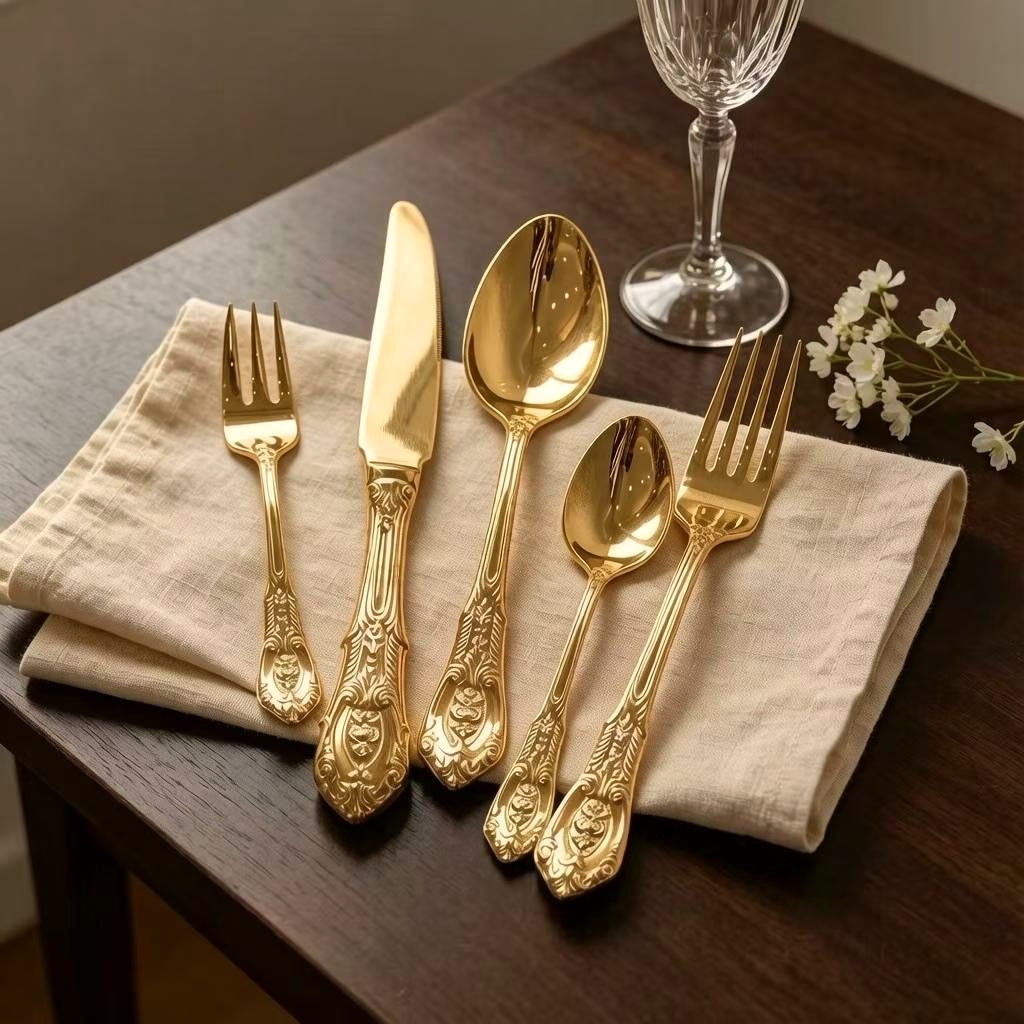
A cutlery set is the piece of hotel equipment guests touch at every single meal, and it is the piece they judge most quickly. A well-chosen set feels balanced in the hand, looks right beside the plate, survives hundreds of wash cycles, and still looks good at the end of a busy season. A poorly chosen set feels light or awkward, shows wear within weeks, and quietly tells guests that the details do not matter here. This guide gives you eight checks to run before you order cutlery sets for your hotel, so the sets you buy suit your covers, your service style, and your team.
1. Count the pieces your service actually needs
A cutlery set is not one thing. A five-piece set typically covers the core of a meal — the pieces a guest needs for a main course, a starter, and dessert — while larger sets add pieces for soup, fish, steak, or a formal multi-course service. Before you choose, list the courses your restaurant actually serves and the pieces each course needs. A breakfast service needs fewer pieces than a banquet dinner, and a property that serves both needs a set that covers the busiest service, not the simplest one.
Work out the pieces per cover, then multiply by your covers. That is the quantity your supplier will ask for, and it is worth getting right: too few pieces and your team will be polishing and re-running cutlery mid-service; too many of the wrong pieces and you have capital sitting in a drawer. When you enquire, name the pieces you need by function — table knife, table fork, dessert spoon, soup spoon, teaspoon — rather than by a generic set name, so the supplier can confirm exactly what is included.
2. Check the weight and balance in the hand
Weight is the first thing a guest notices about cutlery, and it is hard to judge from a photograph. A piece that is too light feels cheap, however good it looks; a piece that is too heavy tires the hand over a long meal. The right weight depends on your dining style — a formal restaurant can carry a heavier piece, a casual breakfast service suits something lighter — but in every case the piece should feel balanced, with the weight sitting comfortably in the middle of the handle rather than at one end.
If you can, handle a sample before you order in quantity. Hold the knife and fork the way a guest would, and check that the handle sits comfortably and the piece does not tip forward or back. Ask your team to try it too — the people who polish and set the cutlery every day will notice a balance problem faster than anyone. A sample is a small step that prevents a large mistake, and a sourcing partner who can arrange one is worth working with.
3. Match the finish to your table and your dining room
The finish of a cutlery set sets the tone of the whole table. A polished, mirror-like finish suits a formal dining room and a banquet; a softer, brushed finish suits a modern restaurant and hides small marks better during a busy service. A gold-toned finish brings warmth to a breakfast buffet and to a classic dining room, and it pairs naturally with gold-toned serving pieces and buffet risers.
Whatever finish you choose, keep it consistent across the property. Mixed finishes on the same table — a polished knife beside a brushed fork — read as improvised, and guests notice even if they cannot name what is wrong. If you are ordering for more than one outlet, decide whether each outlet has its own finish or whether the whole property shares one; a single finish across the hotel is simpler to manage, to replace, and to keep looking consistent. When you enquire, ask for the finish by name and confirm that the whole set — every piece, in every box — carries the same finish.
4. Look at the pattern and the detail
The pattern of a cutlery set is the detail that makes it yours. An ornate pattern suits a classic or luxury dining room and photographs beautifully on a set table; a clean, plain pattern suits a modern restaurant and is easier to keep looking uniform. A shell pattern, a hammered surface, or a simple polished line each give a different impression, and the right choice is the one that matches the rest of your tableware — your plates, your glassware, and your serving pieces.
Check the detail up close. The pattern should be crisp and even across every piece, with no blurry or uneven areas, and the edges should be smooth to the touch. A pattern that is pressed or etched into the surface will wear differently from a plain surface, so ask your supplier how the pattern holds up over repeated washing, and whether the set is suited to the volume of covers your property serves. A set that looks beautiful on arrival but loses its pattern within a season is not a bargain.
5. Test durability against your real wash cycle
Hotel cutlery is washed, dried, polished, and handled hundreds of times a year, and the set you choose has to survive that cycle without losing its finish or its shape. The best test is your own operation: run a sample through your normal wash routine for a few weeks and look at it afterwards. Check the finish for dulling, spotting, or scratches, check the edges for nicks, and check that the pieces still sit flat and straight.
If you use a commercial dishwasher, tell your supplier, and ask how the set performs under your washing conditions — the water, the detergent, the temperature, and the handling. A set that is cared for properly will last far longer than one that is not, so read our flatware care guide before you finalise the routine your team will follow. Durability is not only a property of the cutlery; it is a property of the cutlery plus the way your team treats it, and both halves deserve attention before you order.
6. Work out the right quantity — covers, turns, and spares
Quantity is the check most buyers get wrong, because it is not simply the number of seats. A restaurant that turns each table twice at dinner needs more cutlery than one that turns it once, because the second seating cannot wait for the first seating’s cutlery to be washed, dried, and polished. A banquet that serves five hundred covers at once needs the full quantity on hand at the same moment, plus spares for the pieces that get dropped or damaged.
A practical way to work it out is to count the maximum covers you serve at one time, multiply by the pieces per cover, add a margin for the pieces in washing and in polishing, and then add spares for loss and damage. The margin depends on your operation — a property with a fast, well-staffed wash cycle needs less of it than one where cutlery waits to be polished — but every property needs some. When you enquire, give your supplier the maximum covers, the number of turns, and the pieces per cover, and ask them to confirm the quantity they recommend, so the number is checked by someone who supplies hotels every day.
7. Plan storage, polishing, and the daily reset
Cutlery that is stored well lasts longer and looks better. Pieces should be stored dry, separated by type, and protected from knocking against each other, which is what causes most of the small nicks and scratches that make a set look tired. A drawer with dividers, a canteen box, or a dedicated storage tray all work, as long as the pieces are not piled loosely together.
Polishing is part of the routine, not an occasional rescue. Build a quick polish into the reset between services, and a deeper check into the weekly routine, so water spots and marks never build up. Train the team to handle cutlery by the handle, not by the eating end, and to check each piece as it is set — a bent or spotted piece should be pulled from service before a guest sees it, not after. These habits cost nothing and they are what keep a good set looking good for years.
8. Confirm replacement, re-ordering, and consistency
No cutlery set stays complete forever. Pieces get lost, dropped, or damaged, and a set that cannot be topped up slowly becomes a mix of near-matches. Before you order, confirm with your supplier that the same pattern and finish can be re-ordered later, in the quantities you need, and that a replacement piece will match the set you already own. That confirmation is worth getting in writing.
Also confirm the packing and labelling you need: sets packed per cover, or pieces packed by type, labelled by outlet or by property, and any requirements for your delivery destination. A clear understanding of packing, replacement, and re-ordering before you buy is far easier than a dispute after the goods have arrived. If you are planning a wider tableware refresh, consider ordering your cutlery as part of a single tableware programme so the cutlery, plates, and glassware are planned together and arrive as one coordinated set.
Comparing cutlery sets for a hotel
| Dining style | What to look for | Good fit | Watch out for |
|---|---|---|---|
| Formal restaurant | Balanced weight, polished finish, crisp pattern | A set that feels substantial and looks refined | A light piece that feels insubstantial |
| Casual dining | Comfortable weight, durable finish | A plain or softly patterned set | An ornate pattern that clashes with a relaxed room |
| Breakfast buffet | Warm finish, easy handling, quick polish | A gold-toned set that suits the morning display | Pieces that show water spots quickly |
| Banquet service | Large quantity, consistent finish, easy storage | A matched set ordered by maximum covers | Too few pieces for a full seating |
| Multi-outlet hotel | One finish across outlets, re-orderable design | A single pattern your team can top up | A different finish in every outlet |
What to include in your enquiry
When you ask a supplier for a quote on hotel cutlery sets, a complete enquiry gets you a faster, more accurate answer. Copy and adapt this checklist:
- [ ] The pieces you need by function — table knife, table fork, dessert spoon, soup spoon, teaspoon, and any others
- [ ] The number of covers at your busiest service, and how many turns each table does
- [ ] The finish and pattern you want, and whether the whole property must match
- [ ] The quantity you need, including the margin for washing and polishing and spares for loss
- [ ] Whether you need a sample to handle and test before ordering in quantity
- [ ] How the sets should be packed — per cover, by piece type, labelled by outlet
- [ ] Whether the same pattern and finish can be re-ordered later for replacements
- [ ] Delivery destination, including country and city, and any labelling or packing requirements
- [ ] Your target date for the first service
Send the list with a photo of your current table setting if you have one — a supplier who can see the table will recommend the right set instead of guessing.
Frequently asked questions
How many pieces should a hotel cutlery set have?
It depends on the courses you serve. A five-piece set covers the core of most meals, while a formal multi-course service needs more pieces — soup, fish, steak, or dessert pieces added to the core. List the courses your restaurant serves, work out the pieces each course needs, and order from that list rather than from a generic set name.
How do I choose between a polished and a brushed finish?
A polished finish suits a formal dining room and looks striking on a set table; a brushed finish suits a modern restaurant and hides small marks better during a busy service. Both can be right — the choice should match your dining room and the rest of your tableware, and it should stay consistent across the property.
What weight of cutlery is best for a hotel?
The right weight depends on your dining style, but the piece should always feel balanced in the hand, with the weight sitting in the middle of the handle. Handle a sample before you order in quantity, and ask your team to try it too — balance problems show up faster in the hand than in a photograph.
How much cutlery should I order for my hotel?
Count your maximum covers at one time, multiply by the pieces per cover, add a margin for the pieces in washing and polishing, and add spares for loss and damage. Tell your supplier the covers and the number of turns, and ask them to confirm the quantity they recommend.
Can I order a sample before buying in quantity?
Ask your supplier. A sample lets you check the weight, the balance, the finish, and the pattern in your own dining room, and lets you run it through your wash cycle before you commit to a full order. It is a small step that prevents a large mistake.
How do I keep hotel cutlery looking new?
Handle pieces by the handle, polish them as part of the reset between services, store them dry and separated by type, and pull any bent or spotted piece from service before a guest sees it. Our flatware care guide covers the full routine in detail.
Should every outlet in my hotel use the same cutlery?
A single finish and pattern across the property is simpler to manage, to replace, and to keep consistent. If your outlets have very different styles, they can have their own sets — but keep each outlet consistent within itself, and confirm that each design can be re-ordered.
What pattern suits a classic dining room?
An ornate or shell pattern suits a classic or luxury dining room, while a plain or hammered pattern suits a modern one. The pattern should match the rest of your tableware and the tone of the room, and it should be crisp and even across every piece.
Can I re-order the same cutlery later?
Confirm this with your supplier before you order. A pattern and finish that can be re-ordered protects your table from drifting into mismatched pieces over time, and it means a lost or damaged piece can be replaced rather than forcing a whole new set.
What information does a supplier need to quote cutlery sets?
The pieces you need by function, your maximum covers and turns, the finish and pattern you want, the quantity including spares, whether you need a sample, how the sets should be packed, your delivery destination, and your target date. A photo of your table setting helps the supplier recommend the right set.
How Laiwen HORECA can help
Laiwen HORECA works as a sourcing partner for hotels, restaurants, and catering buyers who need cutlery that fits their covers, their service style, and their dining room. If you are setting up a new restaurant or replacing a worn set, send your pieces list, your maximum covers, the finish and pattern you have in mind, and the quantities you need, and Laiwen will source a matched set — including ornate gold and silver sets, hammered sets, and shell-pattern sets — and quote it for your property. Everything is enquiry-led: there are no fixed prices to look up, so you get a quote built around your quantities and your delivery destination. To start, email [email protected] or message WhatsApp +86 189 9829 7649 (backup +86 134 1816 4320). Browse the wider range in Tableware & Drinkware and plan the rest of your table with our flatware care guide and our guide to planning a tableware programme in one order.